


Posted by Faroo Pets Grooming
on July 27, 2026

TL;DR:
- Pet care businesses adopt booking systems to meet rising client expectations for digital scheduling and reduce operational inefficiencies. These systems increase appointment utilization, decrease no-shows, and free staff to focus more on animal care and client relationships. Choosing a platform that integrates with practice management systems and suits specific workflows is essential for a smooth transition.
Booking systems are the operational backbone of a successful pet care business. They centralize scheduling, automate reminders and vaccination checks, collect payments, and free your team to focus on what matters most: caring for the animals in your charge. Whether you run a grooming salon, a boarding kennel, a mobile service, or a veterinary clinic, the right scheduling platform turns a chaotic phone queue into a calm, predictable day.
Here is what a well-implemented system delivers right away:
- Scheduling efficiency: Appointments fill automatically, buffer times prevent back-to-back chaos, and double-bookings become a thing of the past.
- Client convenience: Pet owners book at midnight, update vaccine records from their phones, and receive automated confirmations without calling your front desk.
- Staff time reallocated to care: Your team stops answering routine scheduling calls and starts focusing on hands-on client and patient work.
Groomers, mobile sitters, boarding facilities, and veterinary practices all benefit, though the specific workflows look different for each. The sections below walk through why adoption matters, which features to prioritize, and how to get a working system live within 30 days.
Table of Contents
- Why do pet care businesses adopt booking systems?
- What features should every pet care booking system include?
- How does a booking system change daily operations by business type?
- How do you choose the right booking system for your practice?
- What pitfalls should you avoid when launching online booking?
- What do booking systems cost, and what ROI can you expect?
- What does the research say about where booking technology is headed?
- Your 30-day implementation checklist
- Key Takeaways
- Booking systems are operations tools, not marketing widgets
- Useful sources to read next
Why do pet care businesses adopt booking systems?
The short answer: client expectations have moved faster than most businesses have. 77% of pet parents now prefer digital communication over phone calls, and 68% say they would actively choose a practice that offers online booking. If your phone is the only way to book, you are already losing clients to competitors who make it easier.
Phone volume is a real operational drain. Every call to schedule a nail trim is a call your receptionist cannot spend on a client standing at the counter. Online booking combined with client portals can reduce scheduling calls by 30–45%, and automated reminders cut no-shows by up to 40%. That combination alone recovers meaningful revenue every month.
After-hours demand is another driver most owners underestimate. About 39% of bookings happen outside business hours, and roughly 24% of direct bookings come from new clients. Without a self-booking option, those appointments simply do not happen.
The impact also shows up in utilization. Boarding facilities using automated reservation systems report kennel utilization of 90–95%, compared to 58–65% with manual systems. For a mid-size practice, that gap can represent $80,000–$180,000 in recovered annual revenue.
There is also a trust dimension. Research from VetTimes shows that more than half of pet parents have experienced booking friction, and younger owners interpret a clunky booking process as a sign of poor overall care quality. A smooth booking flow builds confidence before the client ever walks through your door.
What features should every pet care booking system include?
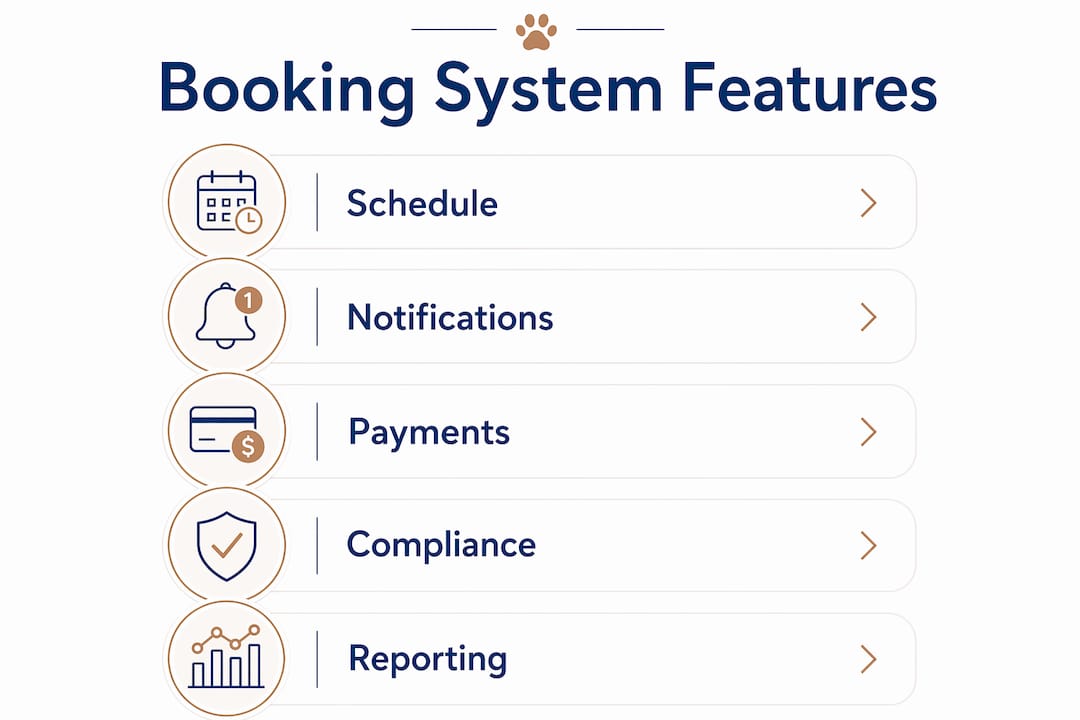
Not all scheduling tools are built for pet care. A general-purpose calendar app will not know that a large-breed bath needs a 20-minute buffer, or that a boarding guest cannot check in without a current Bordetella record. Here is the feature checklist that actually matters:
- Self-booking widget: Lets clients book 24/7 from your website or a direct link, without calling.
- Real-time calendar sync: Prevents double-bookings across staff, rooms, and equipment simultaneously.
- Multi-staff and resource management: Assigns the right groomer, kennel run, or exam room to each appointment automatically.
- Buffer times and booking windows: Adds travel time for mobile groomers or cleanup time between baths; restricts how far in advance clients can book.
- Waitlist automation: Fills cancellations instantly by notifying the next client in line.
- Intake forms and triage questions: Collects breed, size, behavioral notes, and health history before the appointment, so your team arrives prepared.
- Automated reminders and confirmations: Sends texts and emails at set intervals; this is the single biggest driver of no-show reduction.
- Integrated payments and deposits: Collects a deposit at booking to reduce last-minute cancellations and speeds checkout.
- Vaccination verification workflows: Checks records before a boarding stay and alerts clients 72 hours in advance if anything is missing. Automating this check eliminates roughly 80% of compliance-related check-in delays.
- PIMS/EMR integrations: Syncs with your practice information management system so medical records, reminders, and billing stay in one place.
- Reporting and analytics: Tracks utilization, no-show rates, revenue per service, and staff productivity.
- Mobile-friendly client UI: Pet owners expect to book from a phone in under two minutes.
Context-aware scheduling is what separates a basic calendar from a true operational scheduling tool. The best platforms apply conditional logic: a senior dog gets a gentler handler, a giant breed gets a longer slot, and peak-season capacity rules kick in automatically.
Three vendor types worth evaluating represent very different trade-offs. SuperSaaS is a lightweight, general-purpose scheduler that works well for simple grooming or walking services but lacks veterinary-specific workflows. SimplyBook.me offers a broader feature set with custom intake forms, payment integrations, and a client-facing app, making it a solid mid-tier option for groomers and sitters. AllyDVM is built specifically for veterinary practices, with PIMS integrations, medical record syncing, and compliance-aware reminders baked in. Knowing which archetype fits your business type is the first real decision in your vendor search. Understanding what an online grooming booking system actually does at the feature level is a useful starting point before you begin demos.
How does a booking system change daily operations by business type?
The same platform works very differently depending on what you do. Here is how it maps to five common pet care contexts.
Grooming salons benefit most from multi-pet booking flows and package scheduling. A client with two dogs and a cat can book all three in one session, with the system automatically assigning the right groomer and slot length for each animal. Organizing multi-pet appointments without a dedicated system almost always results in scheduling gaps or staff overtime.

Boarding facilities see the biggest operational shift. Kennel assignment, vaccination checks, waitlist automation, and add-on sales (daycare, extra walks, grooming during the stay) can all happen inside the booking flow. A client books a five-night stay, the system checks vaccine records, assigns a kennel run, and prompts the client to add a mid-stay bath. No phone call required.
Mobile groomers and dog walkers need geo-aware scheduling more than almost any other business type. The system blocks travel time between stops, caps daily capacity by route zone, and prevents a groomer from being booked in two neighborhoods at the same time. This is where buffer-time configuration earns its keep.
Pet sitters managing multi-day or overlapping bookings need resource conflict detection. If a sitter has three dogs in-home for the same week, the system should flag when a fourth booking would exceed safe capacity.
Veterinary clinics have the most nuanced needs. Not every appointment type should be self-bookable. Routine wellness visits, vaccine appointments, and nail trims are excellent candidates for online booking. Urgent care, complex diagnostics, and post-surgical rechecks should remain phone-only so staff can triage appropriately. The system should let you restrict service types by booking channel, and it must sync with your PIMS so the medical record is waiting when the patient arrives.

How do you choose the right booking system for your practice?
A structured evaluation process saves months of frustration. Work through these steps before signing any contract.
- Map your service types. List every service you offer and decide which ones are safe to self-book and which require phone triage. This list drives every other decision.
- Confirm PIMS or practice management integration. If you use Cornerstone, Avimark, or another veterinary platform, verify the booking system has a native or API-based integration before anything else.
- Check payment processor compatibility. The system should support your existing processor or offer a built-in option with transparent per-transaction fees and PCI compliance.
- Test the mobile client experience. Book a test appointment on your own phone. If it takes more than two minutes or requires more than four taps, your clients will abandon it.
- Ask about vaccination verification. Can the system automatically block a boarding booking if a pet’s rabies record is expired? Can it notify the client 72 hours before arrival?
- Understand the waitlist flow. How does the system notify waitlisted clients? Is it automatic, or does a staff member have to trigger it manually?
- Confirm deposit and refund handling. Can you set deposit amounts by service type? What happens when a client cancels inside your cancellation window?
- Review reporting capabilities. You need utilization rate, no-show rate, revenue per service, and phone-volume trends at minimum.
- Evaluate data portability and security. Can you export your full client and pet database at any time? Is data encrypted in transit and at rest? Are role-based access controls available?
- Understand the pricing model fully. Per-month subscriptions favor predictability for small businesses. Per-booking fees can surprise you during peak season. Tiered pricing works well when you plan to expand features over time.
Red flags to walk away from: no API or integration options, per-booking fees buried in fine print, a mobile experience that feels like a desktop site shrunk down, and any vendor that cannot explain how complex service types are restricted from self-booking.
Platforms like AllyDVM are purpose-built for veterinary workflows. A general-purpose tool like SimplyBook.me may serve a grooming salon beautifully but fall short for a clinic that needs PIMS sync. Match the vendor archetype to your actual workflow, not to the prettiest demo.
What pitfalls should you avoid when launching online booking?
Most failed rollouts share the same handful of mistakes. Knowing them in advance makes the difference between a smooth launch and a frustrated staff.
- Launching too many service types at once: Start with two or three simple, low-risk services. Adding complexity before the system is stable creates booking errors and erodes staff trust.
- Skipping PIMS data cleanup: Duplicate pet records and outdated vaccine dates will trigger false compliance alerts from day one. Clean your data before migration, not after.
- Making urgent care fully self-bookable: A client booking an “emergency” slot online for a pet that needs immediate triage is a patient safety risk. Keep urgent and complex appointments phone-only.
- Underestimating staff training: The system only works if your team uses it consistently. Build written SOPs and run at least one full end-to-end test with staff before going live.
- Skipping vaccination rule testing: Test every boarding booking scenario with expired, missing, and valid records before opening to clients. One missed rule can result in an unvaccinated pet arriving at your facility.
On the security and compliance side, confirm these before signing:
- Data export available at any time, in a portable format
- Role-based access controls so front-desk staff cannot access billing reports
- Encryption in transit (TLS) and at rest
- PCI compliance for any payment processing
- Clear vendor data retention and deletion policy
Booking automation shifts staff time to higher-value work rather than replacing staff. That reframe matters when you are introducing the system to your team. The goal is not fewer people; it is better-used people.
What do booking systems cost, and what ROI can you expect?
Common pricing models
| Pricing Model | Best For | Watch Out For |
|---|---|---|
| Flat monthly subscription | Small to mid-size groomers, sitters | Feature limits at lower tiers |
| Per-staff pricing | Multi-provider clinics | Costs scale fast with headcount |
| Per-booking fee | Low-volume services | Unpredictable costs during peak season |
| Tiered feature pricing | Growing businesses adding capabilities | Upgrade pressure as needs expand |
For small businesses, a predictable monthly subscription with native payments is usually the right starting point. Veterinary clinics should prioritize PIMS integration and vaccination workflows over price, since the operational cost of a missing integration is higher than any monthly fee.
Sample ROI calculation
The math is straightforward once you have your baseline numbers:
- A boarding facility running at 63% utilization with 20 kennel runs loses roughly 7 nights per run per month to empty capacity. At $45 per night, that is $6,300 in monthly lost revenue. Automated systems that push utilization toward 90% recover most of that gap.
- Cutting no-shows by 40% on a schedule with 10 weekly no-shows at $60 average appointment value recovers $24 per no-show, or roughly $1,000 per month.
- Reducing phone volume by 30% frees a receptionist for approximately 1.5 hours per day. Redirected to client care tasks, that time has real value.
Typical rollout timeline
- Weeks 1–2: Vendor selection, data cleanup, configuration
- Weeks 3–4: Staff training, end-to-end testing, soft launch to a pilot client group
- Month 2: Full client rollout, KPI monitoring, iteration
What does the research say about where booking technology is headed?
The data on pet owner expectations is clear. 68% of pet parents would choose a practice with online booking over one without it, and digital friction actively shortens client loyalty, particularly among younger owners. These are not soft preferences. They are switching triggers.
The next capability shift is context-aware scheduling. Rather than simply showing open slots, modern platforms apply conditional logic to every booking: breed size, staff skill level, seasonal demand patterns, and equipment availability all factor into which slots appear. A large-breed bath does not show up in a 30-minute slot. A groomer certified for aggressive dogs gets assigned automatically when the intake form flags a behavioral note. This is the difference between a calendar and an operational nerve center.
Boarding utilization: manual vs. automated systems
| System Type | Typical Kennel Utilization | Estimated Annual Revenue Impact |
|---|---|---|
| Manual / phone-only | 58–65% | Baseline |
| Automated booking system | 90–95% | +$80,000–$180,000 (mid-size practice) |
Practitioner guidance from operations experts consistently points to one principle: start with routine appointments and prove the system before expanding to complex multi-service bookings. Clinics that try to automate everything on day one almost always encounter data conflicts and staff frustration.
Pro Tip: Phase your rollout by service complexity. Launch nail trims, preventive care visits, and basic grooming first. Add boarding, multi-pet packages, and complex medical appointments only after the system has run cleanly for four to six weeks. This approach catches configuration errors before they affect high-stakes bookings.
Veterinary practices looking to capture more after-hours bookings can also benefit from veterinary SEO services that make their online booking availability discoverable in local search, turning search traffic directly into scheduled appointments.
Your 30-day implementation checklist
A working booking flow is achievable in one month when you follow a phased approach.
Week 1: Define scope and prepare data
- List every service type and decide: self-bookable or phone-only.
- Audit and clean your PIMS or client database (remove duplicates, update vaccine records).
- Choose your pilot services (two to three low-complexity options).
- Set deposit amounts, cancellation windows, and refund rules.
- Select your vendor and sign the contract.
Week 2: Configure the system 6. Build your calendar rules: booking windows, buffer times, and capacity limits. 7. Set up intake forms with breed, size, and health history fields. 8. Configure vaccination verification rules for boarding (72-hour pre-arrival check). 9. Connect your payment processor and test a deposit transaction. 10. Set up automated confirmation and reminder sequences (24-hour and 48-hour pre-appointment).
Week 3: Test everything 11. Run end-to-end booking tests for each pilot service type. 12. Test cancellation, rescheduling, and waitlist flows. 13. Simulate an expired vaccine scenario for boarding. 14. Train all staff with written SOPs; run at least one live walkthrough per role. 15. Test the client-facing mobile experience on at least two device types.
Week 4: Soft launch and monitor 16. Invite a small group of trusted clients to book through the new system. 17. Track KPIs daily: utilization rate, no-show rate, phone volume, booking completion rate. 18. Collect staff and client feedback; fix configuration issues before full rollout. 19. Open booking to all clients once the pilot runs cleanly for five business days. 20. Schedule a 30-day post-launch review to assess KPIs and plan the next service expansion.
Key Takeaways
Booking systems work because they centralize scheduling, automate compliance checks, and shift staff time from phone calls to hands-on care, making every appointment slot more valuable.
| Point | Details |
|---|---|
| Client expectations are digital | 77% of pet parents prefer digital communication over phone calls and 68% would choose practices with online booking; friction drives them to competitors. |
| No-shows and phone volume drop fast | Automated reminders cut no-shows by up to 40%; integrated portals reduce scheduling calls by 30–45%. |
| Boarding utilization is the biggest revenue lever | Automated systems push kennel utilization from ~63% to 90–95%, recovering up to $180,000 annually for mid-size facilities. |
| Phase your rollout by complexity | Start with routine appointments; add boarding and complex services only after the system proves stable. |
| Match the vendor to your workflow | Lightweight schedulers suit groomers; veterinary-specific platforms like AllyDVM suit clinics needing PIMS integration. |
Booking systems are operations tools, not marketing widgets
Most articles about online booking focus on the client-facing benefits: convenience, 24/7 availability, a nicer experience. Those things matter. But the deeper value is what happens on your side of the screen.
When a booking system is configured well, it does not just fill your calendar. It enforces your operational rules automatically. It checks vaccination records so your staff does not have to. It assigns the right groomer to the right breed without a manager making that call. It captures a deposit so a last-minute cancellation does not leave a gap in your revenue. That is not a marketing feature. That is operations design.
The businesses we see get the most from these systems share two habits. They start narrow: two or three services, a small pilot group, clean data. And they prioritize integrations over aesthetics: a system that talks to your PIMS and your payment processor is worth far more than one with a beautiful interface that lives in isolation. The booking flow is only as strong as the data it connects to.
If you are evaluating platforms right now, resist the urge to automate everything at once. Pick the service type where a missed appointment costs you the most, get that working cleanly, and expand from there. The staff time you recover will fund the next phase of the rollout.
Useful sources to read next
These are the most substantive resources used in building this guide. Each one is worth reading in full if you are actively evaluating or implementing a booking system.
-
PetChart: Online Booking & Client Portals 2025 Pet Owner Data — The most cited source in this article. Covers pet parent digital communication preferences, online booking adoption rates, and the revenue impact of integrated portals. Read this before your first vendor demo.
-
US Tech Automations: Veterinary Boarding Reservation Automation — Detailed breakdown of how automation affects kennel utilization, with the utilization and revenue figures cited in the ROI section. Especially useful for boarding facility operators.
-
Otto.vet: Direct Booking in Vet Clinics — Practitioner-level perspective on after-hours booking capture, new-client acquisition through direct booking, and the staff-labor shift argument. Veterinary clinic managers should read this one.
-
VetTimes: Digital Expectations and Booking Friction — Research on how booking friction affects client trust and loyalty, with data on younger pet owner behavior. Useful for making the internal business case for investment.
-
Moego.pet: Scheduling — Covers context-aware scheduling logic, phased rollout best practices, and the operational rules that separate a basic calendar from a true scheduling platform. Particularly relevant for groomers and mobile services.
-
AVMA: Scheduling Technology for Veterinary Practices — The American Veterinary Medical Association’s perspective on scheduling technology adoption, covering workflow integration and staff impact. A credible reference for clinic-level decision-making.
-
UiTM: An Online Scheduling Platform for Veterinary Appointments — Academic research on the usability and operational benefits of web-based appointment systems in veterinary settings. Useful background on why traditional manual systems create downstream problems.
We built Faroopets around the belief that every pet deserves a stress-free, joyful grooming experience, and that starts long before the van arrives. Our booking flow lets you choose your service, pick your time, and confirm your appointment in minutes, whether you have a dog, a cat, or a bird. Browse our full grooming packages and see how easy it is to give your pet the care they deserve, right at your door.
